

Erol Mustafov
CEO & Co-founder, Whispera AI
Your Metadata Is Costing You Money
Weak video metadata makes titles harder to find, harder to classify, and harder to monetise. For smaller content businesses, this is not a technical problem - it is a revenue problem.

The invisible cost of bad metadata
Most content businesses know their metadata could be better. Fewer realise how much revenue that gap is actually costing them.
When content tags and descriptions are inconsistent, incomplete or poorly structured, three things happen:
- Video discoverability drops. Platforms rely on metadata to surface content. If your titles, descriptions, genres and keywords are weak, your catalogue becomes invisible - even when the content itself is strong.
- Contextual advertising suffers. Ad platforms use metadata to match ads to content. Poor metadata means lower CPMs, worse fill rates, and missed ad revenue you never even see.
- Operational friction increases. Every time a team member has to manually fix, reformat or re-enter metadata for a different platform, that is time and money spent on admin instead of growth.
Why smaller publishers feel this most
Large media companies have dedicated metadata teams, taxonomy managers, and enterprise tools. Solo operators, creative collectives, and boutique houses do not.
That means metadata work often falls to the same people managing rights, delivery, and reporting. It gets deprioritised. It gets inconsistent. And over time, it compounds into a structural disadvantage.
The real question
How many monetisation opportunities are you missing because your video metadata is not working hard enough?
Video metadata optimisation is a revenue strategy
The fix is not just “better metadata.” It is treating video metadata optimisation as a first-class operational priority - the same way you treat rights or delivery.
A metadata-first approach means:
- Standardising metadata at the point of ingest, not after delivery fails
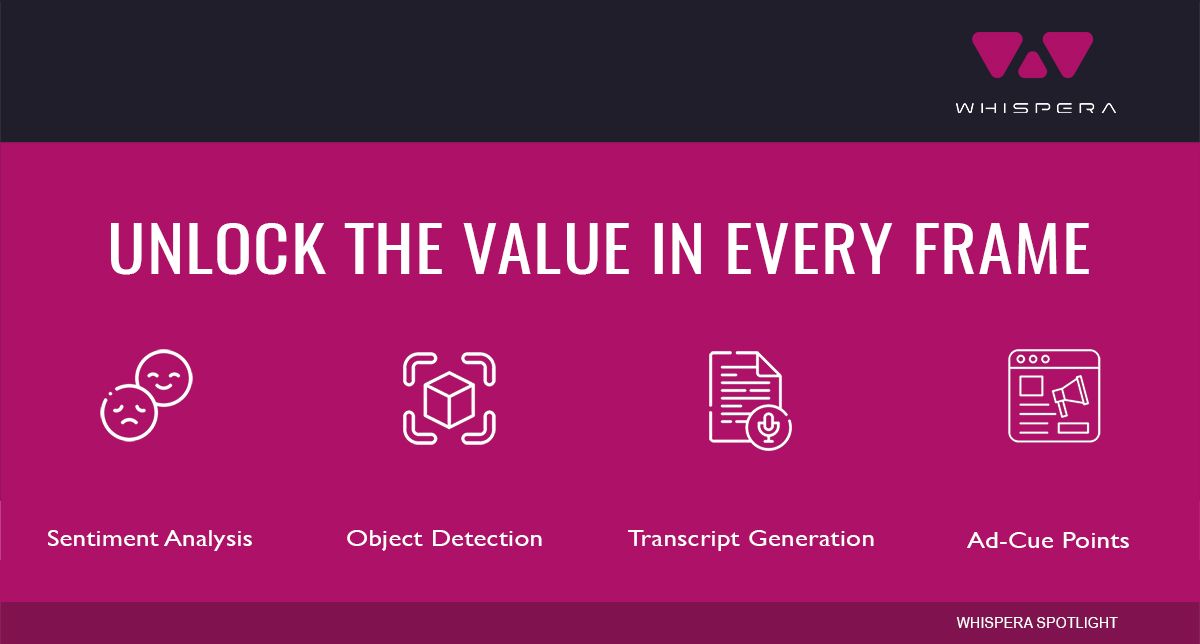
- Enriching titles with keywords, sentiment, and contextual tags that platforms actually use to recommend videos
- Supporting localisation and accessibility from the same workflow
- Connecting metadata quality directly to monetisation performance
What this looks like in practice
Whispera’s metadata enrichment workflow is built around this principle. Content comes in, metadata is standardised and enriched automatically, and the result is titles that are more discoverable, more ad-ready, and more valuable across every platform they reach.
No separate tools. No manual reformatting. No metadata debt building up in the background.
Next step
If your team is still managing video metadata manually - or not managing it at all - that is where revenue is leaking.
Book a demo to see where your catalogue is losing value