

Erol Mustafov
CEO & Co-founder, Whispera AI
Earn More from Your Content Catalogue: Proven Strategies
Most revenue loss isn't a content quality problem - it's a catalogue management problem. Here are five practical strategies to earn more from what you already own.
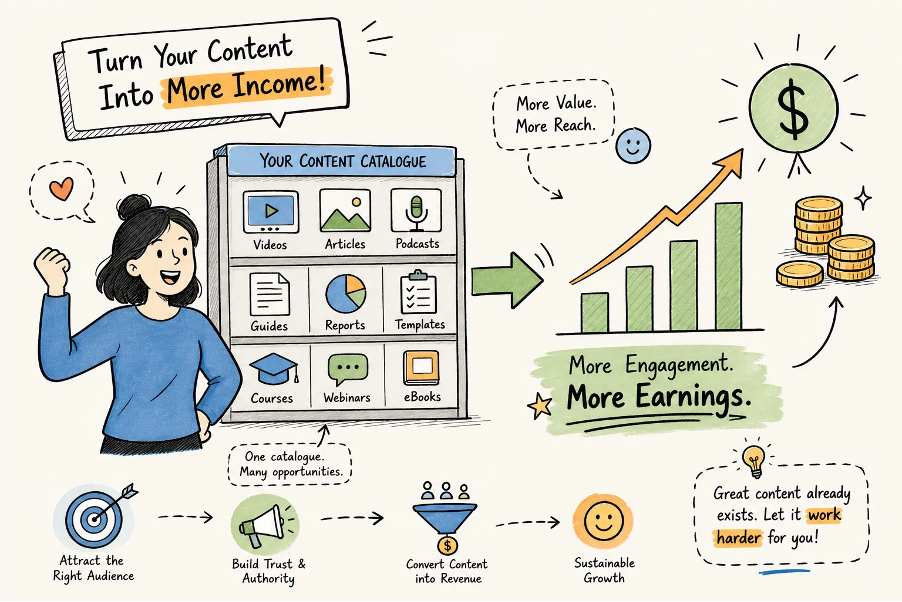
Most independent creators want to earn more from their content catalogue, yet many spend the majority of their time thinking about what to make next. Meanwhile, a catalogue of existing titles sits across platforms doing a fraction of what it could. The content is already made, the rights and paperwork are often incomplete or poorly documented, and the hard creative work is done. What's missing is active management.
This is where significant revenue gets left on the table. Not because the content is bad, but because metadata goes stale, platforms evolve, licensing windows close without renewal, and titles that once performed steadily slip off recommendation algorithms without anyone noticing.
Key insight
The opportunity is not in creating more. It's in managing what already exists with the same intention you brought to making it.
This article covers five practical areas:
- Identifying which titles are quietly underperforming
- Refreshing metadata to restore discoverability
- Expanding distribution to platforms you're not yet on
- Re-licensing older titles for new windows and regions
- Tracking performance so you can see what's actually working
1. Why your content catalogue is your most underused revenue asset
Understanding the silent revenue leak
A back catalogue is not a passive library. It's a revenue engine that either gets maintained or quietly degrades. Rights windows lapse and go unrenewed. Metadata that was optimised in 2022 no longer reflects how audiences search in 2026. Platforms introduce new recommendation signals, and older titles slip out of visibility entirely.
None of this announces itself. It just happens, slowly, while you're busy with the next project.
Anecdotally, many independent creators report running a leaky pipeline without knowing it. Titles not submitted to new platforms, licensing deals that expired with no follow-up, and metadata that no longer matches current search behaviour all represent income that should exist but doesn't.
The real problem
This isn't a content quality problem. It's a content catalogue management problem.
The revenue leak most creators never notice
Revenue leakage from a catalogue is almost always silent. Consider these common scenarios:
- A title available in three territories earns little or nothing in some because the metadata isn't localised
- A licensing deal closed two years ago and the window expired, but no one reviewed it for renewal
- An older video gets impressions on YouTube but click-through rate is poor because the title and thumbnail haven't been touched since upload
Each of these is a small gap individually. Across a catalogue of 20, 50, or 100 titles, they add up to a meaningful shortfall.
2. Identify underperformers with a catalogue audit
Find out which titles deserve attention first
Before optimising anything, you need to know which titles deserve attention first. A catalogue audit sounds like a large spreadsheet exercise, but in practice it comes down to asking a structured set of questions about each title and comparing the answers against what that title could realistically earn.
Running a simple catalogue audit
For each title, the core questions are straightforward:
- How many platforms is it currently live on?
- When was the metadata last updated?
- Has it been licensed to any third parties, and are those agreements current?
The problem most creators face is that the answers live across five or six different platform portals, each with its own dashboard and reporting format. That's why so many titles slip through the cracks - not from neglect, but from the genuine friction of checking multiple systems manually.
Pro tip
Effective content catalogue management starts with bringing all those answers into one place.
Signals that a title is quietly underperforming
The concrete warning signs are worth knowing by name:
- !High impressions, low click-through - a metadata problem, usually in the title or thumbnail
- !No earnings from available regions - suggests a distribution or localisation gap
- !Not submitted to FAST channels - simply absent from potential revenue streams
- !Expired licensing deals - among the most common sources of catalogue revenue loss for UK independent producers
Spotting these signals turns the audit from a theoretical exercise into a prioritised action list.
3. Refresh your metadata to restore discoverability
The highest-return, lowest-effort improvement
Metadata is not a one-time task completed at upload. Platforms update their recommendation logic, search behaviour shifts, and a title optimised in 2022 is competing with 2026 content using outdated signals. Refreshing titles, descriptions, tags, and subtitles on existing content is one of the highest-return, lowest-effort catalogue improvements available.
Research finding
Research from Salsify indicates that enhanced content with richer metadata can lift conversions by up to 36%. For a creator, that translates directly into more views, more streams, and more ad revenue from content that already exists.
What better metadata actually changes on platforms
Platforms like YouTube, Spotify, and FAST services use metadata to decide which content to surface, to whom, and in which regions. On YouTube specifically, the title is the strongest single field for matching user intent, while the description feeds the search index and the recommendation system.
That effect compounds over time. A title that starts appearing in more recommended feeds earns more watch time, which improves its ranking further, which drives more impressions.
Metadata refresh checklist
The fields worth updating on older titles:
- Title - rewritten to match current search language rather than the phrasing you used two years ago
- Description - benefit-led rather than a basic summary
- Tags & keywords - updated to reflect how audiences are actually searching in 2026
- Subtitles & thumbnail copy - accuracy and visual appeal where applicable
Doing this manually for a large catalogue is genuinely time-consuming. Whispera's AI-powered metadata optimisation is built to handle this at scale, improving titles, descriptions, and tags across a catalogue so that creators aren't working through each title individually.
4. Expand distribution and re-license older titles
Get your content in front of new audiences
Distribution is where most independent creators leave the most money behind. Having content live on one or two platforms when it could legitimately earn across five or more is a common situation - and it's one that doesn't require producing anything new to fix.
Where UK creators are missing distribution opportunities in 2026
- FAST channels remain significantly underused by independent video producers. Platforms such as Rakuten TV, Samsung TV Plus, Amazon Freevee, and Virgin Media O2 carry FAST content, reaching entirely new audiences through ad-supported streaming without additional production cost.
- Podcast networks and audio licensing are frequently overlooked by video creators whose content includes substantial spoken-word material.
- Regional licensing to platforms in non-English-speaking markets is rarely explored by UK independents, despite representing a direct revenue opportunity for content with broad subject matter.
Re-licensing older titles
Re-licensing is one of the more straightforward ways to generate incremental revenue from a catalogue. Many older titles have licensing windows that have closed or been poorly documented, leaving content idle when it could be generating income.
The process involves reviewing existing agreements to identify titles with clean rights available for re-licensing, then approaching platforms or third-party distributors with those titles. Whispera's rights and licensing management features are designed to store deals, contracts, and licensing windows in one place, giving creators visibility over renewal dates and helping avoid overlapping agreements.
5. Track performance so you know what's working
Measure, learn, and prioritise
Optimising a catalogue without measuring the results is guesswork. Knowing which changes generated the most uplift is what lets you prioritise the next round of improvements rather than treating every title equally regardless of performance.
The KPIs that tell you if your strategy is working
RPT
Revenue per title
Shows which titles are pulling their weight and which aren't
CTR
Click-through rate changes
Tells you whether your metadata optimisation is landing
GEO
Earnings by platform & region
Identifies where distribution expansion is paying off
LIC
Licensing vs ad revenue
Clear picture of how each revenue stream is performing
These numbers only become useful when they're in one place. Comparing performance across six disconnected platform portals produces unreliable comparisons because the reporting periods, attribution methods, and currency formats rarely align.
Your catalogue is already working. The question is how hard.
Every title in your catalogue is either earning or not, based largely on how well it's managed. The content already exists. The strategies covered here - auditing for underperformers, refreshing metadata, expanding distribution, re-licensing older titles, and consolidating performance tracking - are all actions a solo creator or small team can take without producing a single new piece of content.
The bottom line
The creators who earn more from their existing content catalogue in 2026 are not necessarily the ones making the most content. They're the ones treating what they already own as an active asset rather than a passive archive.
That means running periodic audits, keeping metadata current, reviewing licensing windows before they close, and submitting titles to platforms they're not yet on.
If that sounds like a lot to manage manually, it is. Whispera AI was built specifically for independent producers and small creative teams who want professional-grade catalogue management without the complexity or cost of enterprise tools.
The most useful place to begin is knowing where your catalogue stands right now - and that's where the practical work starts.
Want to know where your catalogue stands?
Take the free quiz and find out what your content could be earning.
Find Your Hidden Revenue